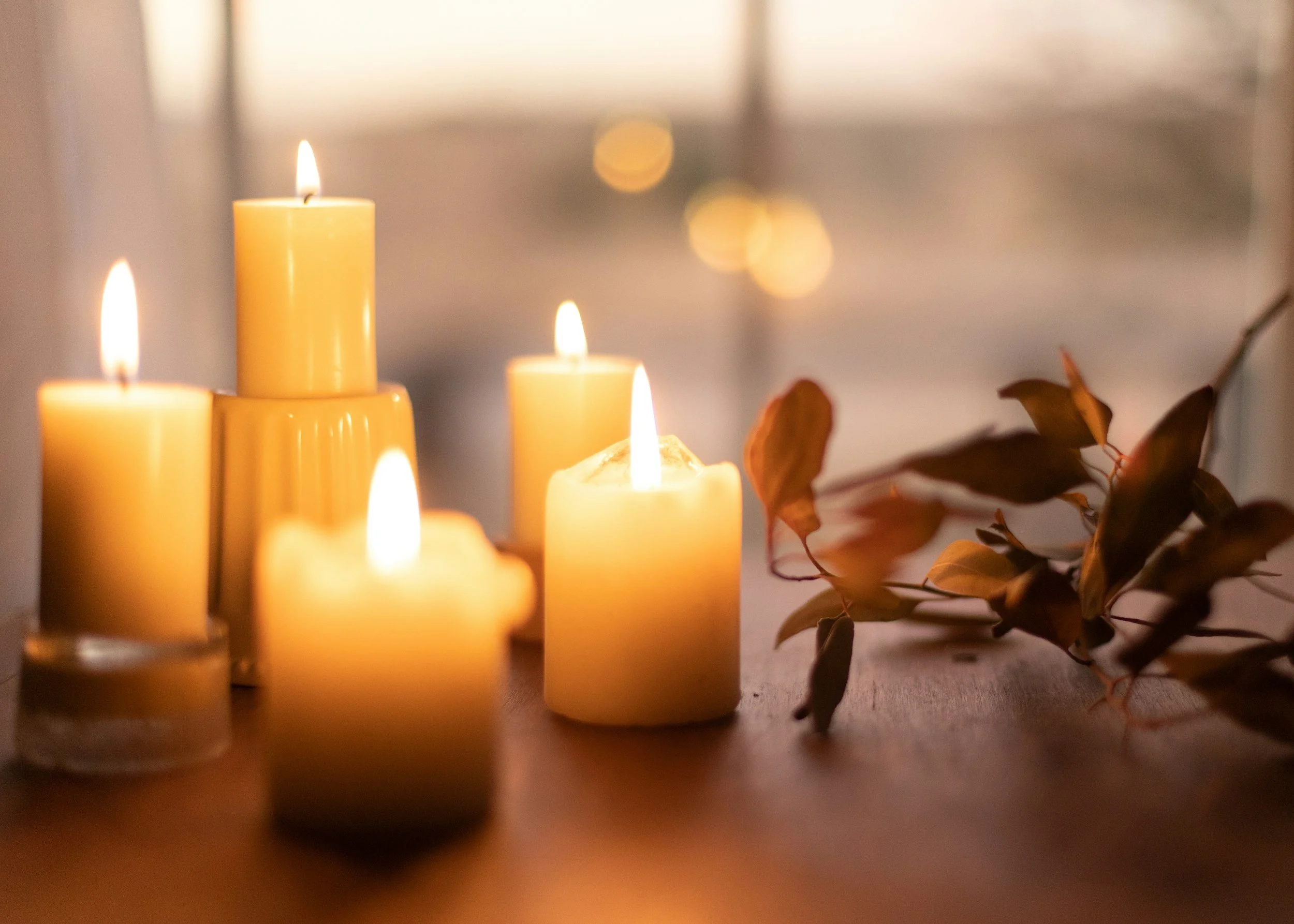
Candles: a ritual of hope and connection
Symbolism and Ritual
I’ve written about handfasting, which I do love and seems to be the internet’s favourite wedding custom right now (hooray!)
But celebrants like me will always include any ritual, symbol or object that has meaning to you in a way that isn’t awkward, random or feels like box ticking.
And I think candles are seriously under-rated!
Whether a wedding or a funeral, they are so versatile and they are rooted in history and symbolism. We use them all the time to mark important moments, don’t we! If nothing else, most of us celebrate our birthdays with a candle (or several) in a cake.
Candles are beautiful inclusions in both funerals and weddings because they create a sense of connection — between you and your partner, or between you and the person who has died. They’ve been used in spiritual and religious contexts for as long as humans have gathered to mark life’s important moments. Before electricity, once the sun went down, candles were the only way to bring light into darkness. They offered hope, comfort, and a sense of the divine in the quietest of spaces.
Across cultures, candles have been lit for gods, for the dead, and for life’s most significant ceremonies. A single flame can feel like a companion — a reminder that even in the darkest moments, there is still warmth, still presence, still light.
Candles symbolise harmony and hope. They bring light to darkness, and that darkness might be grief, sadness, or simply the “before times”: before death, before finding your partner, before your world shifted into something new. In a ceremony, that small flame can hold all of that — the past, the present, and the tender possibility of what comes next.
As a celebrant I am happy to include anything important to you from your religious or spiritual beliefs.
Candles in religion
In Christianity, votive candles are used as part of prayer to God or saints. In Judaism, candles play a vital role in the celebration of Hanukkah, known as the Festival of Lights. The menorah, a nine-branched candelabrum, honours the miracle of the oil that lasted for eight days in the ancient Temple of Jerusalem. I love how candles are used in Buddhism, where candles are used in temples and during meditation to represent the light of wisdom that dispels the darkness of ignorance.
In Hinduism, candles, or oil lamps called diyas, are lit during Diwali, the Festival of Lights, symbolising the triumph of light over darkness and good over evil.
During Kwanzaa, a seven-branched candelabrum known as the kinara is lit to represent the seven principles of the holiday. Each candle symbolises a different value, such as unity, self-determination, and faith.
In Mexico, candles are placed on altars during the Day of the Dead (Día de los Muertos) to guide the spirits of deceased loved ones back to the world of the living. In Sweden and other Scandinavian countries, St. Lucia s Day is celebrated with a procession of girls wearing candle crowns, symbolising light and hope during the dark winter months.
Using candles in ceremonies
As an independent celebrant, I’ll include any candle rituals that matter to you. Candles can bring a beautiful sense of intention to a ceremony — whether you’re honouring a life or celebrating a union — and there are so many ways to use them meaningfully.
For funerals, I often think of the Ancient Egyptians, who believed a candle’s flame could carry prayers to the heavens. They placed candles in tombs to guide the souls of the departed, trusting the light to help them find their way. There’s something tender in that idea — a flame as a companion, a guide, a messenger.
During a ceremony, lighting a candle can offer a moment of stillness. A steady flame can symbolise peace, harmony, or simply the presence of love — whether you’ve found your person or you’re grieving someone who has died. Blowing out a candle can become its own small ritual too: a wish, a prayer, a message carried towards the person you’re missing.
Colours can hold meaning as well. Red is often linked with love and passion; white with purity and protection. These can sit beautifully alongside a handfasting, bringing balance and symbolism to the moment.
Candles can also be personalised. You might carve a symbol or a word into the wax, anoint it with oils, or light it while holding a memory or a hope in mind — a way of honouring the person who has died or visualising the future you’re stepping into. There’s so much room for creativity.
I’m especially fond of candle‑lighting ceremonies, which work gently and powerfully for both funerals and weddings. One by one, or all together, candles can be lit to celebrate a union, to honour a life, or simply to gather everyone in a shared act of remembrance. That collective lighting — many small flames becoming one — speaks of unity, hope, and connection.
Modern Practice
Just a reminder that though it is a beautiful and symbolic addition to a wedding, it does not replace the legal requirements for marriage; Couples still need a licensed official — like a registrar — to conduct a legal wedding ceremony in a licensed venue such as a registry office. It’s a strange and frustrating situation, especially when you consider how personal and meaningful a wedding can be. But this might not be the case for much longer. The government is currently consulting on wedding law reform, and one of the proposed changes could allow independent celebrants like me to hold licences ourselves.
If that happens, couples won’t have to split their day in two: a quick legal ceremony with a registrar, followed by the ceremony they actually want with a celebrant, a handfasting, or any other ritual or cultural element that feels true to them.
And just to be clear — a registry office ceremony cannot include a handfasting or any ritual, religious, spiritual or symbolic elements. That’s why reform matters. It opens the door for couples to have one ceremony that is both legally recognised and deeply personal, rather than having to compromise or duplicate the moment.
If you want to help and give your opinions on wedding law reform you can find the link to the government consultation here (you don’t have to answer every section): Tying the Knot: Reforming weddings law in England and Wales - GOV.UK
Get in Touch
Next week’s post will be on music in ceremonies and, in the meantime, if you want to know more you can check out my Insta @elizabeththedorsetcelebrant where I’m posting about the colour symbolism of hand fasting.
These moments don’t need to be grand.
They just need to mean something to you.
And if you know you’d like to include something but aren’t sure how, or you’ve got lots of ideas and want to shape them into something simpler, or even if you know exactly what you want but not quite where it belongs — that’s where I come in.
I’ll help you find the right place for it.
Be well!
A great celebrant like me knows how to:
Help you pick the rituals that symbolize your stories,
Explain it beautifully, without turning it into a GCSE drama piece,
Weave it into your ceremony so it feels like part of the story, not a random intermission,
I read the room with care — knowing when to bring a little brightness, when to soften the moment, and how to let each shift in tone land exactly where it needs to.